1. Step Into History at the Antiquarium
Every unforgettable journey begins with context. Our three-hour guided tour opens at the Antiquarium of Pompeii, where the story of this extraordinary city comes into sharp focus. Here, artifacts recovered from centuries of excavation introduce you to the daily rhythms of Roman life: finely crafted jewelry, household objects, fresco fragments, and tools that once filled bustling homes and workshops.
Rather than simply observing relics behind glass, you will understand how these objects functioned within a thriving urban system. We examine the social hierarchy, economic networks, and cultural influences that shaped Pompeii before the catastrophic eruption of 79 AD. This foundation transforms the ruins from silent stones into a living, breathing city—one you are about to explore step by step.
2. The Forum: Political and Economic Power Center
From the museum, we move directly into the civic heart of the city: the Forum. Framed by colonnades and dominated by the looming presence of Mount Vesuvius, this vast open plaza once served as Pompeii’s political, religious, and commercial nucleus.
As your guide, I reconstruct the Forum’s dynamic atmosphere. Senators debated policy. Merchants negotiated contracts. Citizens gathered for announcements and ceremonies. We analyze the basilica’s legal function, the temples’ religious significance, and the infrastructure that kept commerce flowing. By reading architectural cues and spatial organization, you will see how Roman urban planning reflected power structures and public life.
Standing here, you do not merely view ruins—you grasp the mechanics of a functioning Roman municipality.
3. The Plaster Casts: Faces of the Final Hours
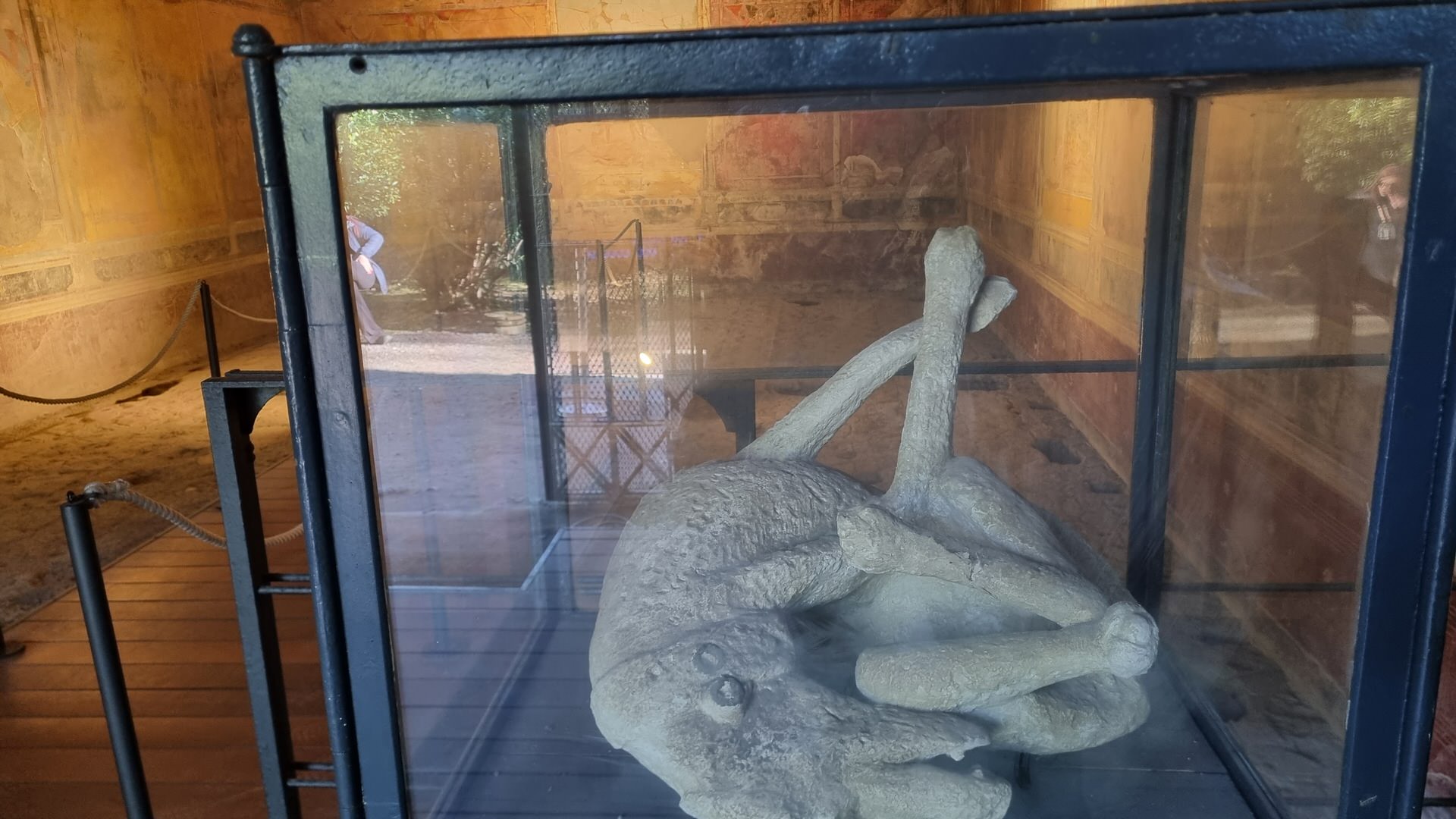
Few moments are as emotionally powerful as encountering the plaster casts of Pompeii’s victims. These casts preserve the precise forms of individuals overtaken by volcanic ash nearly two millennia ago.
I guide you through the scientific technique developed in the 19th century to create these casts and explain what they reveal about the eruption’s sequence. The expressions, postures, and even the folds of clothing provide archaeological evidence of sudden catastrophe.
This portion of the tour is handled with respect and clarity. It is not about spectacle; it is about human connection. The casts remind us that Pompeii was not merely a city of monuments—it was a community of real people whose final moments were preserved in ash.
4. The House of the Vettii: Wealth, Private Life, and Roman Humor
Next, we enter one of the most refined residences in the city: the House of the Vettii at Pompeii. Recently restored, this domus offers an unparalleled glimpse into elite domestic architecture.
Owned by two freedmen who rose to prominence through commerce, the house reflects both wealth and ambition. Lavish frescoes depict mythological scenes rich with symbolism. The peristyle garden demonstrates Roman aesthetic sophistication and engineering skill.
One of the most memorable sights is the cheeky fresco of Priapus, the Roman god of fertility, depicted weighing his unusually oversized phallus against a bag of money right at the entrance — a bold ancient statement that wealth, good luck, and a healthy libido went hand in hand! This wasn’t just “Roman humor,” but also a symbolic charm meant to protect the home and bring prosperity.
Here, I decode the iconography on the walls, explain the function of each room, and illustrate how status was communicated architecturally. You will see how private life intersected with public reputation in Roman society. The result is not simply admiration of art, but comprehension of social mobility, identity, and even the playful side of Roman culture.
5. Bread and Business: The Bakery and Thermopolium
To understand Pompeii, we must examine its economy at street level. We visit a fully preserved bakery, complete with millstones and ovens, where grain was transformed into bread for daily consumption. You will learn about supply chains, labor organization, and dietary habits within the city.
Just steps away stands a remarkably intact thermopolium—an ancient fast-food establishment. Its decorated counter and embedded jars once held hot food and wine for customers on the go. This stop reveals the practicality of Roman urban living and the vibrancy of neighborhood commerce.
These spaces demonstrate that Pompeii was not only monumental—it was industrious, entrepreneurial, and deeply human.
6. The Theater: Entertainment and Civic Identity
Our tour concludes at the theater, where performance and public spectacle shaped civic identity. Here, comedies, tragedies, and musical performances entertained audiences drawn from across the social spectrum.
I explain the acoustic engineering, seating hierarchy, and political symbolism embedded in the structure. In doing so, you will appreciate how entertainment reinforced cultural cohesion and social order.
As we stand within this ancient venue, the experience comes full circle. From governance to domestic life, from commerce to culture, the theater encapsulates the city’s vitality.
In just three hours, this guided exploration of Pompeii offers far more than a walk among ruins. It is a structured, immersive experience grounded in archaeology, history, and human narrative. Through expert interpretation and carefully curated stops—including the Antiquarium, Forum, plaster casts, House of the Vettii, bakery, thermopolium, and theater—you gain not only knowledge, but perspective.
Pompeii is not frozen in time. With the right guide, it speaks.